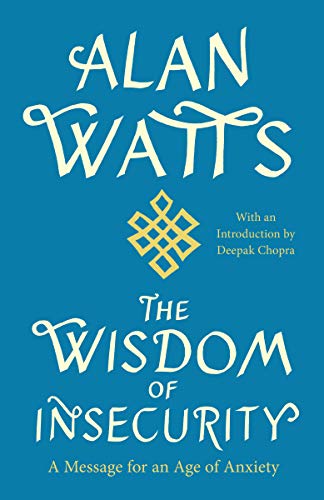
This little book has contains a lot of valuable insights. I’ve summarised the book here and left all my notes at the end.
The high level premise is insecurity is created as a result of trying to be secure. The harder we cling to somthing, the more insecure we are in life. Instead, Watts says that we must let go of belief and instead turn to faith: “Belief clings, but faith lets go”. He argues that we cannot find meaning in life until we accept that life has no meaning.
The present moment is satisfying enough without having to rationalise it through the lens of the past or the future. This causes more pain. And removes us from the present. Taking away from our present experience and therefore our life. He uses the example of the business man that focus so much on making money they do not spend it.
The conciousness “I” is really just a stream of present experience. But we try to make sense out of life by fitting it into frameworks beyond this. This causes difficulty because any desire for permanence will be damaging when the real world is in constant flux. “Ideas and words are more or less fixed, whereas real things change”
Many complex processes in our body are performed without any instruction or awareness from us. The body lives entirely in the present. We digest food, breathe, sleep, grow hair. Just because that is what the body does. Watts calls this “the basic mind”. He suggests leaving more of our lives to gut instinct and going with the flow of our unconcious mind.
Watts breaks down the barrier between the I and the present moment. Saying that if I only experience the present moment, then essentially I am the present moment. Even more conceptually, there really is no “I” here. Just experience. The “I” is what wrongly tries to control and rationalise life. Which only brings us pain. Because you can never truly be an observer of your present experience because the moment you reflect on it, the experience changes.
He warns against experiencing the present through the lens of the past. Where we take our present experience and liken it to similar past experiences. This is an attempt to rationalise the experience, therefore creating an “I” and an experience. Which as he mentioned, leads to suffering. “when we try to understand the present by comparing it with memories, we do not understand it as deeply as when we are aware of it without comparison”.
He goes further to say that all life is a common “I”, which is the present experience. The sun. The earth. The flowers. Me. They are all the same thing. They are all the present moment. Because “if you and your thoughts are part of this universe, you cannot stand outside them to describe them”.
Says that the “divided mind” is the source of what we typically call evil. Because the divided mind is tempted by pleasures to save the “I” from this present moment and move it to another. But “so long as the mind believes in the possibility of escape from what it is at this moment, there can be no freedom”.
At the beginning of the book Watts says that we should not try to explain life. Instead we should just live it through “faith”. He closes off by suggesting that religion serves this purpose in society. That we use “God” as a way to faithfully accept the present moment with no need for rationalisation.
The Age of Anxiety
- Human beings appear to be happy just so long a hey have a future to which they can look forward
- If happiness always depends on something expected in the future, we are chasing a will-o’-the-wisp that ever eludes our grasp
- during the past century the authority of science has taken the place of the authority of religion
- For man seems to be unable to live without myth - Needs meaning
- Somehow we must grab what we can while we can, and drown out the realization that the whole thing is futile and meaningless. - Result of lack of belief
- abandonment of belief, of any clinging to a future life for one’s own, and of any attempt to escape from finitude and mortality, is a regular and normal stage in the way of the spirit.
- Accept the truth, hold no hard beliefs - Quite nihilistic
- Faith, on the other hand, is an unreserved opening of the mind to the truth
- Belief clings, but faith lets go.
- The present phase of human thought and history is especially ripe for this “letting go.”
- we likewise find life meaningful only when we have seen that it is without purpose
Pain and Time
- If we are to have intense pleasures, we must also be liable to intense pains
- The real problem does not come from any momentary sensitivity to pain, but from our marvellous powers of memory and fore-sight—in short from our consciousness of time.
- For the animal to be happy it is enough that this moment be enjoyable. But man is hardly satisfied with this at all. He is much more concerned to have enjoyable memories and expectations
- Our pain comes from not being present
- The present cannot be lived happily unless the past has been “cleared up” and the future is bright with promise.
- it is of little use to us to be able to remember and predict if it makes us unable to live fully in the present.
- If, then, my awareness of the past and future makes me less aware of the present, I must begin to wonder whether I am actually living in the real world
- trouble of those business men who live entirely to make money. So many people of wealth understand much more about making and saving money than about using and enjoying it. They fail to live because they are always preparing to live.
The Great Stream
- Every form is really a pattern of movement, and every living thing is like the river, which, if it did not flow out, would never have been able to flow in.
- the stream of change
- consciousness-the thing you call “I”-is really a stream of experiences, of sensations, thoughts, and feelings in constant motion.
- “I” and “me,” the head and the body - Mind body split
- a war between consciousness and nature, between the desire for permanence and the fact of flux
- We think that making sense out of life is impossible unless the flow of events can somehow be fitted into a framework of rigid forms - Can’t fit it into framework because nature if fluid
- Ideas and words are more or less fixed, whereas real things change
- it is extremely hard to describe the most important characteristic of life-its movement and
- To want life to be “intelligible” in this sense is to want it to be something other than life.
- man must surrender his separate-feeling “I,” and must face the fact that he cannot know, that is, define the ultimate.
The Wisdom of the Body
- how to breathe, swallow, see, circulate the blood, digest Food, or resist diseases. Yet these things are performed by the most complex and marvellous processes - The Body
- attempt to solve our problems by conscious thinking rather than unconscious “know-how.” This is much less to our advantage than we like to suppose
- Human desire tends to be insatiable.
- the basic mind which knows reality rather than ideas about it, does not know the future. It lives completely in the present
- For this stream of stimulants is designed to produce cravings for more and more of the same, though louder ard faster, and these cravings drive us to do work which is of no interest save for the money it pays
- The real trouble is that they are all totally frustrated, for trying to please the brain is like trying to drink through your ears. Thus they are increasingly incapable of real pleasure, insensitive to the most acute and subtle joys of life
- The brainy modern loves not matter but measures - Benchmarks
- in a not too distant future the human brain may be an obsolete mechanism - Sooner than the body
- the brain is made for man, not man for his brain
- After all, the brain is not a muscle, and is thus not designed for effort and strain - Disagree
- Working rightly, the brain is the highest form of “instinctual wisdom.” - Gut instinct
On Being Aware
- How are we to heal the split between “I” and “me,” the brain and the body, man and nature and bring all the vicious circles which it produces to an end? - Problem to solve
- to be aware of life, of experience as it is at this moment, without any judgments or ideas about it.
- The word “awareness” is used in the sense given to it by J. Krishnamurti
- If I am split in two pieces. There must be a good “I” who is going to improve the bad “me.”
- You want to be happy, to forget yourself, and yet the more you try to forget yourself, the more you remember the self you want to - Striving for security breeds insecurity
- What we have to discover is that there is no safety - !
- The principal thing is to understand that there is no safety or security.
- this centre and soul of our being which we call “I.”
- “I” does not exist.
- approach our experience our sensations, feelings, and thoughts quite simply, as if we had never known them before
- Memory is a form of experience - We only exist in the present
- There is simply experience - There is no I
- I <—> Present experience
- life is entirely momentary
- get the “I” out of the experience - Causes suffering and is impossible
- I must be aware of it with my whole being.
- So long as you are calling it names and saying, “I am happy,” or “I am afraid,” you are not being aware of it
The Marvellous Moment
- I shall get information about your name and address, your business and personal history. But I asked who you are, not who you were
- No possibility remains but to be aware of pain, fear, boredom, or grief in the same complete way that one is aware of pleasure.
- There are, then, two ways of understanding an experience
- compare it with the memories of other experiences, and so to name and define it. This is to interpret it in accordance with the dead and the past.
- be aware of it as it is, as when, in the intensity of joy, we forget past and future, let the present be all, even stop to think, “I am happy.
- when we try to understand the present by comparing it with memories, we do not understand it as deeply as when we are aware of it without comparison.
- But why are we trying to be separate from fear?
- every experience is in this sense new,
- One has to make the experiment
- It consists in being completely sensitive to each moment, in regarding it as utterly new and unique, in having the mind open and wholly receptive
- A body of water does not run away when you push it; it simply gives
- resistance as a defence only makes it worse - Striving for security breeds insecurity
- It experiences pain in the same complete, unselfconscious way in which it experiences pleasure.
- Wanting to get out of pain is the pain
- you have really no choice but to be aware-because you cannot separate yourself from the present and you cannot define it - !
- to name is to interpret experience by the past
- If we are open only to discoveries which will accord with what we know already, we may as well stay shut - Do not interpret experience by the past (pointless)
The Transformation of Life
- this transformation consists in knowing and feeling that the world is an organic unity - Everything is “I”
- The sensation of a house across the street or of a star in outer space is no less I than an itch on the sole of my foot or an idea in my brain.
- inextricably interwoven process called the real world
- That there is a sun apart from my sensation of it is an inference
- your sensation of the sky is the sky, and there is no “you” apart from what you sense,
- all the qualities which we admire or loathe in the world around us are reflections from within
- you do not run around the countryside thinking, “I am all this.’, there is simply “all this”
- The feeling that we stand face-to-face with the world, cut off and set apart, has the greatest influence on thought and action. - !
- if you and your thoughts are part of this universe, you cannot stand outside them to describe them. - Godel?
- there is no past and no future, you must relax and taste to the full
- The meaning and purpose of dancing is the dance. Like music, also, it is fulfilled in each moment of its course. You do not play a sonata in order to reach the final chord
- When each moment becomes an expectation, life is deprived of fulfilment
Creative Morality
- The more my actions are directed toward future pleasures, the more I am incapable of enjoying any pleasures at all
- For all pleasures are present, and nothing save complete awareness of the present can even begin to guarantee future happiness
- most of the acts which, in conventional morals, aré called evil can be traced to the divided mind.
- By far the greater part of these acts come from exaggerated desires, desires for things which are not even remotely necessary for the health of mind and body
- So long as there is the motive to become some-thing, so long as the mind believes in the possibility of escape from what it is at this moment, there can be no freedom. - The Divided Mind
- the undivided mind is not moved into those escapes from the present which are usually called “evil.”
- regulations based on rewards and punishments - Bad morality - no real freedom
- A mind that is single and sincere is not interested in being good,
- Its interest is not in itself, but in the people and problems of which it is aware
- Love as if seeing everything as part of yourself? —> Present experience
Religion Reviewed
- trying to say that words and ideas do not explain reality
- Meaning behind thoughts and words - God
- God = Eternal present
- “Christ” is the realization that there is no separate “I”.
- you have no “I” to surrender. You are completely free to do this at any moment, and nothing whatever is stopping you. This is our freedom - !
- It is obvious that the only interesting people are interested people, and to be completely interested is to have forgotten about “I” - Interested awareness
- God is unknown to those who know him, and is known to those who do not know him at all.” - Could easily replace ‘god’ with ‘happiness’ here
- free from trying to understand itself thought can think