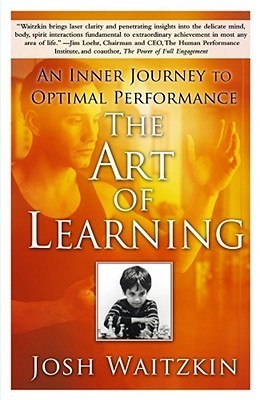
“Essence” - At its core, the key of this book is internalising the essence of any discipline’s fundamentals, expanding that study to more complex topics, then relaxing so your subconcious can perform at its peak when needed.
The Life of Josh Waitzkin
Chess
- First saw chess being played in the park at 6 years old, by 7 he was the highest ranked in his age group in the USA
- Later became famous from his Dad’s book “Searching for Bobby Fischer”. Handling the fame was hard
- Competed for years, under the guidance of GM chess masters
- Frequently took time off of chess for a few weeks to go on the boat with family, learned the importance of downtime and rest
- Lost national championships at 9 years old, learned the importance of using loss to improve
- From 9 - 17, “key ingredient to my success in those years was that my style on the chessboard was a direct expression of my personality”. Learned to love the game of learning chess, wether he won or not. But also understood that winning was still the goal.
- “We need to put ourselves out there, give it our all, and reap the lesson, win or lose.”
- “there will be nothing learned from any challenge in which we don’t try our hardest. Growth comes at the point of resistance. We learn by pushing ourselves and finding what really lies at the outer reaches of our abilities.”
- At 17 he competed and there was an earthquake which kicked his mind into solving a chess problem, this was his first discovery of the soft zone. Flow state that is accepting of external events, not demanding them to be a certain way
- “You flow with whatever comes, integrating every ripple of life into your creative moment.”
- “have a more resilient concentration.”
- “_When uncomfortable, my instinct is not to avoid the discomfort but to become at peace with it”
- Around the same time he also learned “_the importance of regaining presence and clarity of mind after making a serious error.” In order to avoid a downward spiral.
- “The first mistake rarely proves disastrous, but the downward spiral of the second, third, and fourth error creates a devastating chain reaction.”
- “I would occasionally leave the playing hall and sprint fifty yards outside._”
- Travelled the world with a chess notebook and a backpack, reiginited his love for chess
- Chess became less about success and more about self discovery. As he said, he was changing voice
- “When I was twenty-one years old and came back to America, I was more in love with the study of chess than ever.”
- Breaking stallions - Either (a) Tie it up or (b) Teach it that it need not run away, as it wont be harmed
- “By taking away our natural voice, we leave ourselves without a center of gravity to balance us as we navigate the countless obstacles along our way.”
- He came to a crossroads of chess coach - Coach 1 wanted him to learn classical defensive chess, which was not his style but would polish his weaknesses, while Coach 2 wanted him to learn defense from the best attacking players, maintaining his attacking flair.
- He chose the Coach 1 and it led to the end of his chess career.
Tai Chi
- Started Tai Chi in New York, was drawn to it by eastern philosophy (Dharma Bums)
- Learned the flow, then begun push hands fighting
- Got better and better, trainging constantly
- Became US champion after 2 years of training, world champion after 5 years
- Attended Push hands world championships in Taiwan multiple times
- 1st time - Immediately knocked out
- 2nd time - Bronze
- 3rd time - Gold
We learn more about his learning process through Tai Chi than we do through Chess (Interestingly, there is no mention of (a) work/how he made money (b) friendship of any kind. He even mentions a girlfriend but not one friend or job)
Learning a New Craft
Numbers to Leave Numbers
(A level of understanding where knowledge is intuitive)
- “A chess student must initially become immersed in the fundamentals in order to have any potential to reach a high level of skill.”
- “Initially one or two critical themes will be considered at once, but over time the intuition learns to integrate more and more principles into a sense of flow.”
- “It is important to understand that by numbers to leave numbers, or form to leave form, I am describing a process in which technical information is integrated into what feels like natural intelligence.”
- “What was once seen mathematically is now felt intuitively.”
Growth Mindset
- Carol Dweck theory
- Incrementalist theory vs entity theory
- How children respond to difficulty depends on how they were raised
- “You are good at that” = Entity theory
- “You worked hard at that” = Incrementalist
Beginner’s Mind
- “I was a beginner, a child learning to crawl, and the world began to lift off my shoulders. Chess was irrelevant on these wooden floors.”
- “I practiced for hours every evening.”
- “It took full concentration to pick up each valuable lesson,“
Investing in Loss
(Remove your ego to learn)
- Loss is an investment
- Focus on technique over strength, you will lose in the short term, but once your technique is honed you will be miles ahead of the people using strength
- “one of the most challenging leaps for Push Hands students is to release the ego enough to allow themselves to be tossed around while they learn how not to resist.”
- “Investment in loss is giving yourself to the learning process.”
- Fail fast and repeat failures as little as possible
- “It’s clear that if in the beginning I had needed to look good to satisfy my ego, then I would have avoided that opportunity and all the pain that accompanied it.”
- Investing in loss and beginners mind are easy when you are a beginner, but to keep it going after years and years in a sport is harder (people are expecting things of you)
- “that it is essential to have a liberating incremental approach that allows for times when you are not in a peak performance state.”
Making Smaller Circles
(Highly deliberate practise)
- Be highly focused in your training
- Ensure you focus on the fundamentals
- Once you have the movement, make it smaller (less movement) while maintaining its essence
- “the most common error in the learning of martial arts: to take on too much at once.”
- “I focused on small movements, sometimes spending hours moving my hand out a few inches,”
- “The key was to recognize that the principles making one simple technique tick were the same fundamentals that fueled the whole expansive system of Tai Chi Chuan.”
- “incrementally condense the external manifestation of the technique while keeping true to its essence”
- Quality > quantity
Using Adversity
(Injury and how to use it)
- Time off the mats is great for mental preparation
- Many QBs in the NFL credit success to a few months out with injury
- Train around injury as you can, make your weak side into your strong side
- If he didn’t train when sore or hurting, he would never train
- “You should always come off an injury or a loss better than when you went down.”
- “_In all athletic disciplines, it is the internal work that makes the physical mat time click”
- Make obstacles spur you on
- “Ultimately we should learn how to use the lessons from this type of experience without needing to get injured: a basketball player should play lefty for a few months”
Slowing Down Time
(Offloading computation to the subconcious)
- “Everyone at a high level has a huge amount of chess understanding, and much of what separates the great from the very good is deep presence, relaxation of the conscious mind, which allows the unconscious to flow unhindered.”
- Offloading large amounts of info to the subconcious high speed processor so that you can focus on a few details efficiently in the concious. Hence time feels slowed down
- “my unconscious navigates a huge network of subtly programmed technical information, and my conscious mind is free to focus on certain essential details”
- “The key, of course, is practice.”
The Illusion of the Mystical
(Reading cues & creating setups)
- “At the opponent’s slightest move, I move first”
- Mental programming - “the controlling of intention”
- “The battle becomes about reading breath patterns and blinks of the eye,”
- “In virtually every competitive physical discipline, if you are a master of reading and manipulating footwork, then you are a force to be reckoned with.”
- “We taped our training and every week I broke down the video.”
Internal Creation of Inspiring Conditions
The Power of Presence
- “In every discipline, the ability to be clearheaded, present, cool under fire is much of what separates the best from the mediocre.”
- “In the absence of continual external reinforcement, we must be our own monitor, and quality of presence is often the best gauge.”
- “We cannot expect to touch excellence if “going through the motions” is the norm of our lives. On the other hand, if deep, fluid presence becomes second nature, then life, art, and learning take on a richness”
- “The more present we are at practice, the more present we will be in competition,“
Searching for the Zone
(Learn to relax quickly, both mentally and physically)
- “Players who are able to relax in brief moments of inactivity are almost always the ones who end up coming through when the game is on the line.”
- “the better we are at recovering, the greater potential we have to endure and perform under stress.”
- Do interval training with incrementally higher intensity and lower rest
- “In your performance training, the first step to mastering the zone is to practice the ebb and flow of stress and recovery. This should involve interval training”
- Practise meditation in order to have relaxation whenever you need it
- “The unconscious mind is a powerful tool, and learning how to relax under pressure is a key first step to tapping into its potential.”
Building Your Trigger
(Channel your serene activity into a trigger for performance)
- Find your serene activity
- Create a 4 or 5 step routine
- This routine will, over time, connect to the serene state of mind
- Incrementally condense the routine (eg. 10% shorter meditation, 5 minute later wake up, …)
- Ensure you make changes slowly, barely noticable to your subconcious
- “I should be able to condense the practice to its essence.” - True compression
Making Sandals
(To thrive under any circumstances, control yourself, not the circumstances)
- “To walk a thorny road, we may cover its every inch with leather or we can make sandals.”
- “when our emotions overwhelm us, we can get sloppy.”
- “First, we learn to flow with distraction, like that blade of grass bending to the wind. Then we learn to use distraction, inspiring ourselves with what initially would have thrown us off our games. Finally we learn to re-create the inspiring settings internally. We learn to make sandals.”
- “I sought out dirty players and got better and better at keeping cool when they got out of control.”
- Use their shit talking as fuel until they give up. Be the guy that gets better when heckled
- Michael Jordan was a big shit talker, but nobody ever shit talked back because he would only go and score more points
- “Instead of running from our emotions or being swept away by their initial gusts, we should learn to sit with them, become at peace with their unique flavors, and ultimately discover deep pools of inspiration.”
- “Discover what emotional states work best for you and, like Kasparov, build condensed triggers so you can pull from your deepest reservoirs of creative inspiration at will.”
Exampls of Grit & Hard Work
- “some days I would play countless speed chess games, hour after hour”
- “Since I was twelve years old I had kept journals of my chess study, making psychological observations along the way—now I was doing the same with Tai Chi.”
- “After thousands of slow-motion, ever-refined repetitions of certain movements, my body could become that shape instinctively.”
- “It’s amazing how many hundreds of hours I spent laboring my way through Dvoretsky’s chapters, my brain pushed to the limit, emerging from every study session utterly exhausted, but infused with a slightly more nuanced understanding of the outer reaches of chessic potential.”
- “Every day I did this subtle work at home and then tested it in class at night.”
- “In the two years before the 2004 Taiwan tournament, Dan and I basically lived on the mats together.”
- “For the final three months before Taiwan, I recorded all of Dan’s and my training sessions. Then, every night I would go home and study the tapes.”
- “First I worked on each step slowly, over and over, refining my timing and precision. Then I put the whole thing together, repeating the movements hundreds, eventually thousands of times.”
- “From 2000 to 2002, I studied these tapes in detail and slowly refined my game.” - 2 years perfecting specific areas of his game
Side Notes on High Level Performance
- “I have come to understand that these little breaks from the competitive intensity of my life have been and still are an integral part of my success.”
- “Our lessons now included raucous speed chess sessions with breaks to toss a football outside. We began to laugh and connect as human beings as we had in our first sessions years before.” - Connecting personally with coach
- “One of the most critical strengths of a superior competitor in any discipline—whether we are speaking about sports, business negotiations, or even presidential debates—is the ability to dictate the tone of the battle.”
- “To my mind, the fields of learning and performance are an exploration of greyness—of the in-between.”
- “A key component of high-level learning is cultivating a resilient awareness that is the older, conscious embodiment of a child’s playful obliviousness.”
- “Mental resilience is arguably the most critical trait of a world-class performer, and it should be nurtured continuously.”
- “It is rarely a mysterious technique that drives us to the top, but rather a profound mastery of what may well be a basic skill set.”
- “My understanding of learning was about searching for the flow that lay at the heart of, and transcended, the technical.”
- “First things first—I had to begin with an understanding of the art’s foundation.” - Always
- “I have long believed that if a student of virtually any discipline could avoid ever repeating the same mistake twice—both technical and psychological—he or she would skyrocket to the top of their field.”
- “there is more than one solution to virtually every meaningful problem. We are unique individuals who should put our own flair into everything we do.”
- “The real art in learning takes place as we move beyond proficiency, when our work becomes an expression of our essence.”
- “At the highest levels of any kind of competitive discipline, everyone is great. At this point the decisive factor is rarely who knows more, but who dictates the tone of the battle.”