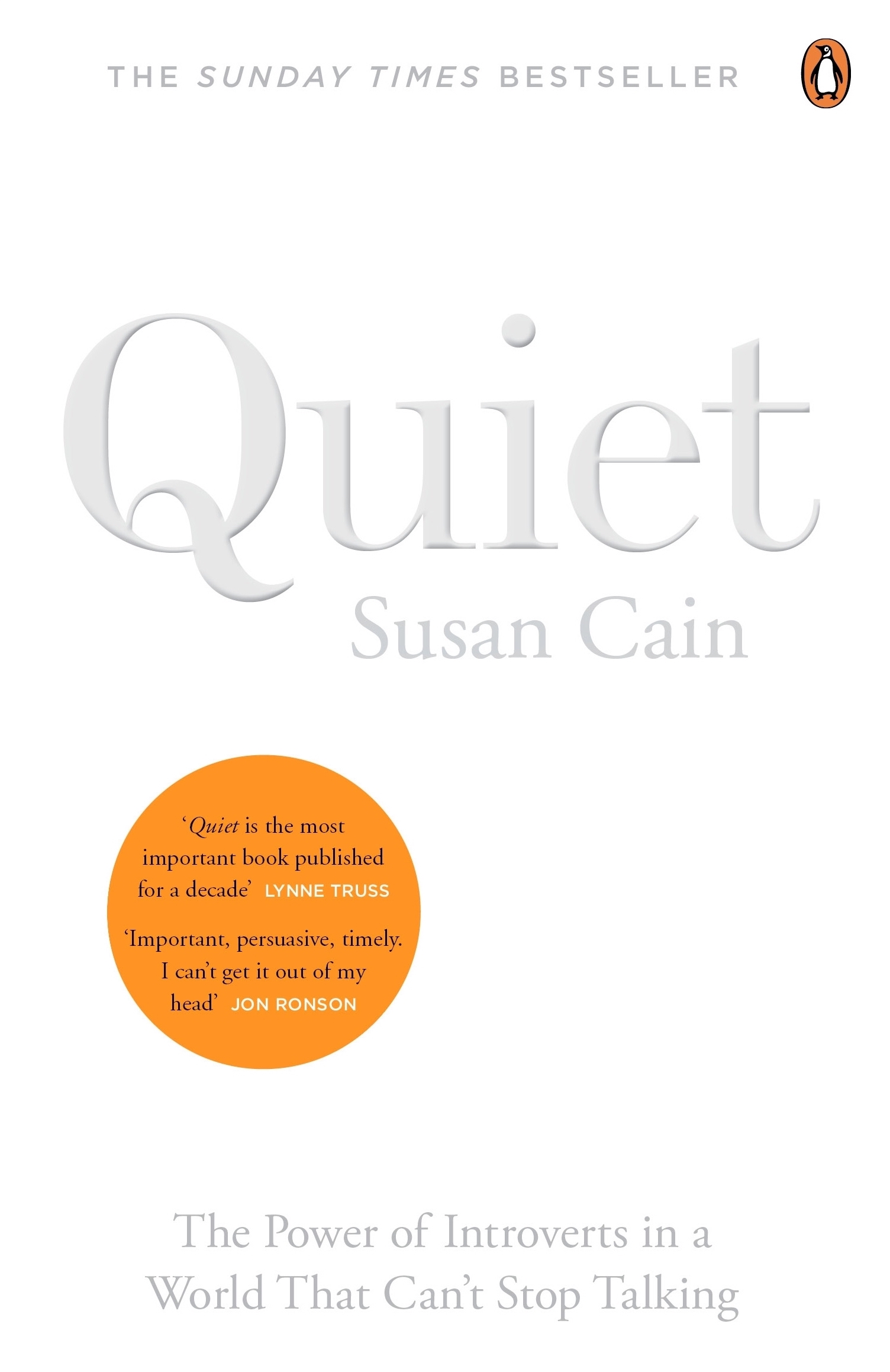
At times I did not like the book, as it suggests that introverts are precious little snowflakes. On the other hand, it also points out that the vast majority of breakthroughs in quality of life came from introverts. It is usually the thinkers that come up with new ideas, art, and technologies.
My favourite quotes
“Neither E=mc2 nor Paradise Lost was dashed off by a party animal” > “It’s not that I’m so smart,” said Einstein, who was a consummate introvert. “It’s that I stay with problems longer.”
The Extrovert Ideal
- We moved from a culture of character to a culture of personality
- Augmented by the self help movement - “Be more charismatic, interesting, funny, …”
- “In the Culture of Character, the ideal self was serious, disciplined, and honorable. What counted was not so much the impression one made in public as how one behaved in private.”
- ““The social role demanded of all in the new Culture of Personality was that of a performer,”
- College and Companies both wanted extroverts - “to take into account not only what the college wanted, but what, four years later, corporations’ recruiters would want.”
- So parents drove their kids to fit that mold - “Well-meaning parents of the midcentury agreed that quiet was unacceptable and gregariousness ideal for both girls and boys.”
- But actually the best CEOs are introverts, they are better leaders generally
- “The one and only personality trait the effective ones I have encountered did have in common was something they did not have: they had little or no ‘charisma’ and little use either for the term or what it signifies.””
- “But when he analyzed what the highest-performing companies had in common, the nature of their CEOs jumped out at him. Every single one of them was led by an unassuming man like Darwin Smith.” - Jim Collins - good to great
- “introverts are uniquely good at leading initiative-takers. Because of their inclination to listen to others and lack of interest in dominating social situations,”
- Studies of group dynamics show that being extroverted does nothing more than squash the good ideas of introverts - “If we assume that quiet and loud people have roughly the same number of good (and bad) ideas, then we should worry if the louder and more forceful people always carry the day. This would mean that an awful lot of bad ideas prevail while good ones get squashed. Yet studies in group dynamics suggest that this is exactly what happens.”
- Expertise is typically acquired in solitude, a place introverts spend a lot of time
- Steve Wozniak - “When you read his account of his work process on that first PC, the most striking thing is that he was always by himself.”
- “introverts prefer to work independently, and solitude can be a catalyst to innovation.”
- “Serious study alone” is the strongest predictor of skill for tournament-rated chess players,”
- “two best groups spent most of their music-related time practicing in solitude: 24.3 hours a week,”
- Deliberate Practise - “It’s only when you’re alone that you can engage in Deliberate Practice,”
- “Studies have shown that performance gets worse as group size increases:“
Your Biology, Your Self?
- Temperament to introversion or extroverion is about 50% nature 50% nurture
- “suggested that introversion and extroversion, like other major personality traits such as agreeableness and conscientiousness, are about 40 to 50 percent heritable”
- “the footprint of a high- or low-reactive temperament never disappeared in adulthood.”
- “Schwartz’s research suggests something important: we can stretch our personalities, but only up to a point.”
- Introverts are more easily overstimulated than extroverts. And that is often a biological trait they have had since birth
- “understand introversion and extroversion as preferences for certain levels of stimulation”
- “there’s a host of evidence that introverts are more sensitive than extroverts to various kinds of stimulation, and that introverts and extroverts often need very different levels of stimulation to function at their best.”
- This higher sensitivity has many traits associated with it
- “highly sensitive tend to be philosophical or spiritual in their orientation, rather than materialistic or hedonistic.”
- “They feel exceptionally strong emotions—sometimes acute bouts of joy, but also sorrow, melancholy, and fear.”
- “The other thing Aron found about sensitive people is that sometimes they’re highly empathic”
- “the most high-reactive, the ones who are likely to be introverts who feel the guiltiest.”
- “The more responsive your brain is to dopamine, or the higher the level of dopamine you have available to release, some scientists believe, the more likely you are to go after rewards like sex, chocolate, money, and status.”
- “Extroverts’ dopamine pathways appear to be more active than those of introverts.”
- “Introverts also seem to be better than extroverts at delaying gratification, a crucial life skill”
- “when you’re focused on a project that you care about, you probably find that your energy is boundless”
- Finding your flow state - Optimal stimulation
- “You can set up your work, your hobbies, and your social life so that you spend as much time inside your sweet spot as possible.”
- “The key to flow is to pursue an activity for its own sake, not for the rewards it brings.”
- “in flow, “a person could work around the clock for days on end, for no better reason than to keep on working.””
Do All Cultures Have an Extrovert Ideal
- The west tends to be extroverted while the east introverted
- “Chinese high school students tell researchers that they prefer friends who are “humble” and “altruistic,” “honest” and “hardworking,” while American high school students seek out the “cheerful,” “enthusiastic,” and “sociable.””
- “Asian attitudes to the spoken word: talk is for communicating need-to-know information; quiet and introspection are signs of deep thought and higher truth.”
- “excellent students seem not only to possess the cognitive ability to solve math and science problems, but also to have a useful personality characteristic: quiet persistence.”
How to Love, How to Work
- To what extent should we adjust our personality (within a range) for certain situations/people?
- “According to Free Trait Theory, we are born and culturally endowed with certain personality traits—introversion, for example—but we can and do act out of character in the service of “core personal projects.””
- “explains why an introvert might throw his extroverted wife a surprise party or join the PTA at his daughter’s school.”
- Self Monitoring
- “the introverts who were especially good at acting like extroverts tended to score high for a trait that psychologists call “self-monitoring”
- “the highest self-monitors not only tend to be good at producing the desired effect and emotion in a given social situation—they also experience less stress while doing so”
- “I’m doing this to advance work I care about deeply, and when the work is done I’ll settle back into my true self.”
- But we should only do this for core personal projects, things important to us
- “there are three key steps to identifying your own core personal projects.”
- “First, think back to what you loved to do when you were a child.”
- “Second, pay attention to the work you gravitate to.”
- “Finally, pay attention to what you envy.”
- “there are three key steps to identifying your own core personal projects.”
- Stay connected to your true self, it avoids burnout
- “Restorative niche” is Professor Little’s term for the place you go when you want to return to your true self. It can be a physical place, like the path beside the Richelieu River, or a temporal one, like the quiet breaks you plan between sales calls.”
- “Emotional labor,” which is the effort we make to control and change our own emotions, is associated with stress, burnout, and even physical symptoms”
- Romance
- “the two types are often drawn to each other—in friendship, business, and especially romance.”
- “It can be hard for extroverts to understand how badly introverts need to recharge at the end of a busy day.”
- “It’s also hard for introverts to understand just how hurtful their silence can be.”
- “In couples where the man is introverted and the woman extroverted, as with Sarah and Bob, we often mistake personality conflicts for gender difference,”
- Introverts have so much value to offer
- “So when introverts assume the observer role, as when they write novels, or contemplate unified field theory—or fall quiet at dinner parties—they’re not demonstrating a failure of will or a lack of energy. They’re simply doing what they’re constitutionally suited for.”
- “when introverts are able to experience conversations in their own way, they make deep and enjoyable connections with others.”